Overview
In recent years, financial reinforcement learning (FinRL) with deep reinforcement learning (DRL) has shown huge potentials in obtaining profitable trading strategies in complex market conditions. The inherently noisy and complex real-world markets makes DRL a compelling approach to adapt and learn the optimal trading strategy. However, to effectively learn from the noisy market data, market environments are essential to decrease the simulation-to-reality gap.
Despite the importance, many open-source market environments have remained outdated and in- consistently maintained. Differences in data sources and API design hinder reproducibility and makes it difficult to integrate and test agents across environments. Moreover, community initiatives such as FinRL Contests require standardized market environments to ensure fair and reproducible evaluation of agents. The challenges highlights the demand to organize current open-source market environments
Motivation
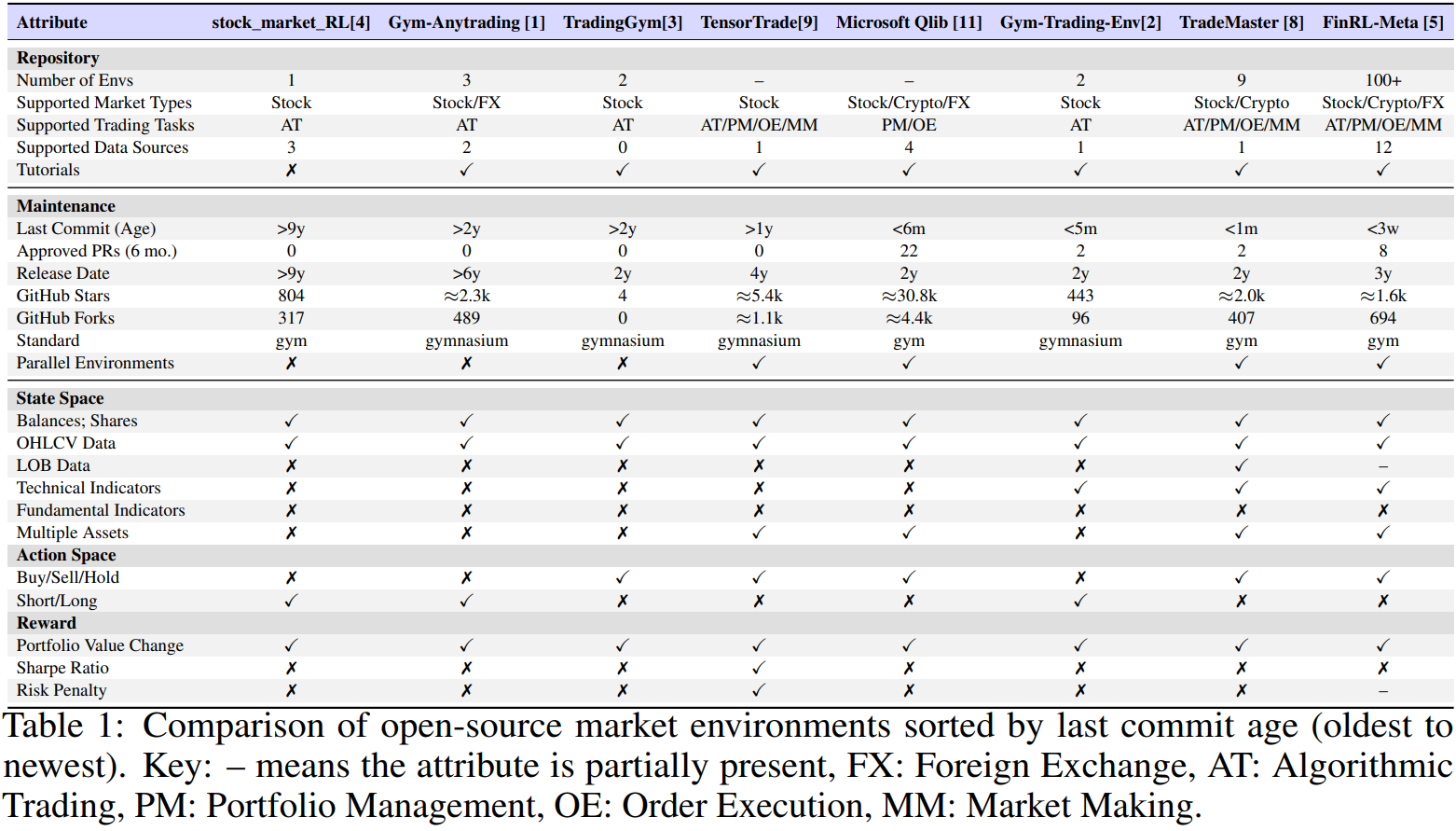
We conducted a systematic survey of open-source market environments and evaluated their development and maintenance status using a set of attributes. The results, as summarized in Table 1, reveal the following issues:
Maintenance status (e.g., last commit age, user guide, and tutorials)
Some repositories show low commit activity or few approved pull requests, indicating limited ongoing support and maintenance.
Outdated environments risk compatibility issues with modern libraries and hinder reproducibility.
Several lack documentation and user guides or tutorials, making it difficult for new users to adopt and integrate.
Coverage and diversity (e.g., market types, number of environments, and data sources)
Some repositories have limited use of mainstream data sources, which hinders users from testing data of different market types and time frames.
Some repositories only cover stock markets, without support for other markets such as cryptocurrency and forex.
Environment design (state space, action space, and reward)
State, action, and reward definitions vary between environments, so a clear organization and classification would benefit users.
Some repositories do not support important tasks such as multi-asset portfolio management, limiting their applicability.
These observations highlight a gap in this field and emphasize the need for market environments to be better organized, evaluated, and standardized. To address this issue, we develop standardized evaluation pipelines for stock and crypto trading tasks to systematically evaluate market environments.